
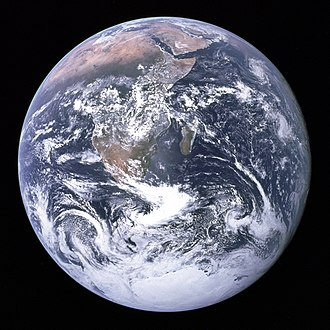
The Earth seen from Apollo 17
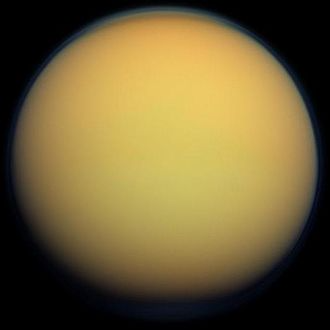
Titan in true color
Tearth /Ttitan the Φ
==============
Tmean.earth 288 Κ
So = 1.361 W/m² (So is the Solar constant)
S (W/m²) is the planet's solar flux.
For Earth S = So
Earth’s albedo: aearth = 0,306
Earth is a smooth rocky planet, Earth’s surface solar irradiation accepting factor Φearth = 0,47
(Accepted by a Smooth Hemisphere with radius r sunlight is S*Φ*π*r²(1-a), where Φ = 0,47)
N = 1 rotation /per day, is Earth’s axial spin
cp.earth = 1 cal/gr*oC, it is because Earth has a vast ocean. Generally speaking almost the whole Earth’s surface is wet. We can call Earth a Planet Ocean.
==========
Titan (Saturn's moon)
Tsat.mean.titan = 93,7 K (- 179,5 oC)
Titan has an atmosphere of 95% N2 nitrogen plus 5% of greenhouse gas methane CH4. Titan has a minor greenhouse effect phenomenon. This phenomenon is so insignificant that it hasn't appeared in calculations.
Link:
"The atmosphere of Titan is largely nitrogen; minor components lead to the formation of methane and ethane clouds and heavy organonitrogen haze.
The climate—including wind and rain—creates surface features similar to those of Earth, such as dunes, rivers, lakes, seas (probably of liquid methane and ethane), and deltas, and is dominated by seasonal weather patterns as on Earth.
With its liquids (both surface and subsurface) and robust nitrogen atmosphere, Titan's methane cycle bears a striking similarity to Earth's water cycle, albeit at the much lower temperature of about 94 K (−179 °C; −290 °F)."
Titan’s albedo:
atitan = 0,22
1/R² = 1/9,5826² = 1/91,826 = 0,010890
Titan’s sidereal rotation period is 15,9 days
Titan does N = 1/15,9 rotations per day (synchronous rotation)
Titan is a rocky planet, it has atmosphere of 95% N2 and 5% CH4, but very opaque.
Titan’s atmosphere is 8 times larger with respect to square meter planet’s surface compared to Earth, so we consider Titan a gaseous planet and Titan’s surface irradiation accepting factor Φtitan = 1.
Titan's surface can be considered as a liquid methane ocean planet, Cp.methane = 0,4980 cal/gr*oC
==========
Comparison Coefficient:
[ (1-a) So (1/R²) (N*cp)¹∕ ⁴ ]¹∕ ⁴
*************
Earth:
[ (1-a) So (1/R²) (N*cp)¹∕ ⁴ ]¹∕ ⁴
[ (1-0,306)1.361*1* (1*1 )¹∕ ⁴ ]¹∕ ⁴ =
[ (0,694)1.361*1*1 ]¹∕ ⁴ =
(944,534) ¹∕ ⁴ = 5,54376
************
Titan:
[ (1-a) So (1/R²) (N*cp)¹∕ ⁴ ]¹∕ ⁴
{ (1-0,22)*1.361*0,010890*[(1/15,945)*0,4980]¹∕ ⁴ }¹∕ ⁴ =
[ (0,78)*1.361*0,010890*(0,031232)¹∕ ⁴ ]¹∕ ⁴ =
[ (0,78)*1.361*0,010890*(0,42039) ]¹∕ ⁴ =
(4,859950)¹∕ ⁴ = 1,484766
************
(Coefficients Comparison)
5,54376 /1,484766 = 3,7338
***********
Tearth /Ttitan = 288K /93,7K = 3,07364
**********
Φ:
(Tearth /Ttitan) /(Coefficients Comparison)
3,07364 / 3,7338 = 0,82319
Φ = (0,82319) ⁴ = 0,4592 = 0,46
====