Written by Christos I. Vournas,
M.sc. mechanical engineer
We do planets and moons surface temperatures comparison.
The presence of atmosphere doesn't warm Earth's surface.
It is the other reasons, not the presence of atmosphere, that make Earth warmer than the Moon by +68°C.
///////////////////
Key words:
Specular Reflection
Φ - Solar Irradiation Accepting Factor (spherical shape and surface roughness coefficient), for smooth bodies Φ = 0,47 and for rough / porous Φ = 1
Immediate IR Emission
Rotational Warming Phenomenon ( N*cp )1/16
///////////////////
Tmean.pluto
So = 1.362 W/m² (So is the Solar constant)
Pluto’s albedo: apluto = 0.49 to 0.66 (geometric) Let’s have apluto = 0.50
1/R² = 1/39,48² = 1/1.558 = 0,0006418
Pluto’s sidereal rotation period is 6,38723 days
Pluto does N = 1/6,38723 rotations/ per day
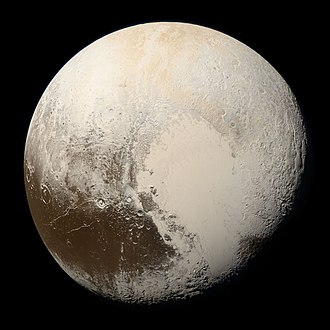
Pluto is a nitrogen ice crust surface planet, very cratered, and Pluto’s surface solar irradiation accepting factor Φpluto = 1.
Pluto's surface is composed of more than 98 percent nitrogen ice.
Pluto can be considered as a nitrogen ice crust surface planet,
Cp.nitrogen N2 = 0,24845 cal/gr*oC
β = 150 days*gr*oC/rotation*cal – it is the Planet Surface Solar Irradiation INTERACTING-Emitting Universal Law constant
σ = 5,67*10⁻⁸ W/m²K⁴, a Stefan-Boltzmann constant
Surface temp. min mean max
Kelvin 33 K 44 K (−229 °C) 55 K
Pluto’s mean surface temperature equation Tmean.pluto is:
Tmean.pluto = [ Φ (1-a) So (1/R²) (β*N*cp)¹∕ ⁴ /4σ ]¹∕ ⁴
Τmean.pluto = { 1*(1-0,50)*1.362 W/m² *0,0006418*[150 *(1/6,38723)* 0,24845]¹∕ ⁴ /4*5,67*10⁻⁸ W/m²K⁴ }¹∕ ⁴ =
Tmean.pluto = 41,59 K
Tsat.mean.pluto = 44 K (- 229 oC)
Notice:
Pluto has moderately eccentric orbit e = 0,2488 during which it ranges from 30 to 49 astronomical units or AU (4.4–7.4 billion km) from the Sun.
Pluto has orbital period of 247,94 years.
The New Horizons spacecraft performed a flyby of Pluto on July 14, 2015, becoming the first ever, and to date only, spacecraft to do so. During its brief flyby, New Horizons made detailed measurements and observations of Pluto and its moons.
The Pluto–Charon barycenter came to perihelion on September 5, 1989.
These makes us conclude that when the New Horizons on July 14, 2015 made its measurements of Puto's mean temperature Pluto was only 26 years away from the perihelion, so Pluto was still pretty much closer to the sun than its semi-major axis.
On July 14, 2015 the dwarf planet was approximately at 32.9 AU from the Sun.
And this partly explains the difference between the calculated and the measured Pluto's mean surface temperatures.
.
https://www.cristos-vournas.com
The faster a planet rotates (n2>n1) the higher is the planet’s average (mean) temperature T↑mean:
Tmin↑→ T↑mean ← T↓max
.
Table of contents - Links
0). Explain Rotational Warming Model.
Demonstrate the Initial PREMISE, Links: (1) and (2)
3).The Planetary Temperatures Comparison Criteria.
4). "The total amount of the specularly reflected portion of solar flux"
5). How A Planet Retains The Solar Energy - the role of the Immediate IR emission.
6). Φ -Factor is an analogue of the well known Drag Coefficient Cd=0,47
7). “What ‘portion’ of ‘sunlight’ reaches surface of Earth?”
8). The satellites do not measure Bond Albedo.
9). Stefan-Boltzmann formula J = σ T4 W/m² doesn't apply to terrestrial temperatures.
10). The Theoretical Equation.
12). The actual reason of the observed Global Warming.
13). The Axial Precession's role in Global Warming.
14). The Original Milankovitch cycle.
15). The Reversed Milankovitch cycle.
16). The higher CO2 content in ice core samples relates to colder periods.
17). Sensible Heat /Latent Heat ratio.
18). The conventional greenhouses, and the role of immediate IR emission.
19). NASA Technical Memorandum An Earth Albedo Model
20). The yearly total Immediate IR Emitted solar energy - in our times - is lower.
21). The yearly total reflected solar energy - in our times - is lower.
Appendix - Links
1). Earth's Corrected Effective Temperature (210 K ) calculation.
2). Earth's Average Surface Temperature (288 K ) calculation.
3). Moon's Corrected Effective Temperature (224 K ) calculation.
4). Moon's Average Surface Temperature (220 K ) calculation.
5). Mars' Corrected Effective Temperature (174 K ) calculation.
6). Mars' Average Surface Temperature (210 K ) calculation.
7). Mercury's Corrected Effective Temperature (364 K ) calculation.
8). Mercury's Average Surface Temperature (340 K ) calculation.
9). Titan's Average Surface Temperature (93,7 K ) calculation.
10). Earth / Mars satellite measured mean surface temperatures 288 K and 210 K comparison.
11). Earth's /Moon's temps 288K /220K comparison.
13). Blog.
*******************
The table of contents will be completed some time soon. For more pages view the menu at the top.
*******************